

NetSuite eCommerce Integration
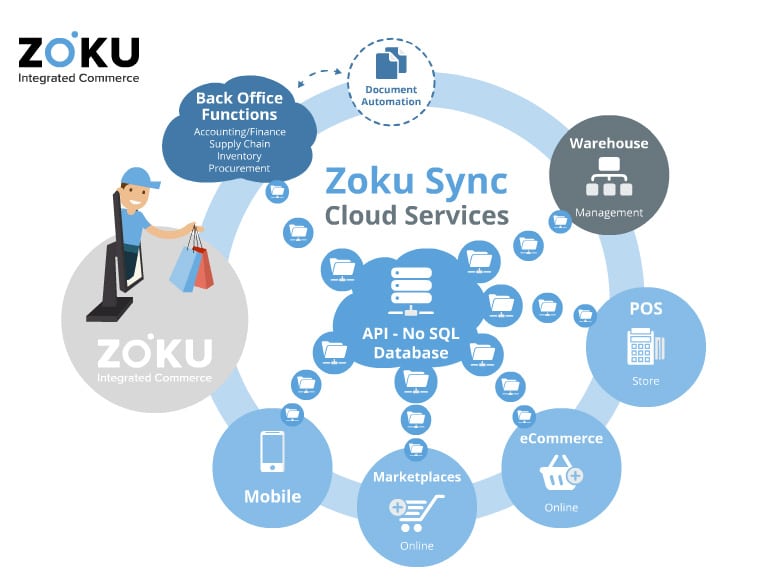
Zoku Sync helps Retail, Food & Beverage and Wholesale operators easily connect all the disparate touchpoints together, whether it’s mobile app data, in-store POS transactions, CRM systems, eCommerce platforms, or third-party logistics providers. By unifying these data sources into a single, centralized view, Zoku Sync eliminates silos that typically slow down operations.
Thanks to its standardized integration approach and a growing library of pre-defined connectors, new touchpoints can be added quickly and with minimal technical effort. This flexibility empowers businesses to adapt to evolving consumer expectations while maintaining consistent service across all channels. The result is a 360° view of the customer, enabling more informed decision-making, personalized engagement, and a truly seamless omni-channel retail strategy that drives loyalty and repeated business.
The open architecture, tools, and APIs make it simple to localize and contextualize across regions, channels, and customer segments.
Simple APIs, scalability at runtime and during deployment, and a rock-solid core that intermediates between systems with different integration strategies by buffering, throttling, intelligently routing data, and handling errors without ever dropping the ball.
-
A scalable core system that can spread loads over 1 to 1000 nodes at a time
-
A simple REST API for management and data queries
-
Web-based configuration dashboards
-
99.99% uptime guarantee
-
256-bit encryption of all data and connection keys
ZOKU SYNC FEATURES




Why NetSuite eCommerce Integration Matters
Integrating NetSuite with your eCommerce platform is essential for retailers aiming to streamline operations and scale effectively. By connecting systems like POS, CRM, inventory, and online storefronts, businesses eliminate manual data entry and reduce errors across the board. This leads to faster order processing, better inventory accuracy, and a more consistent customer experience across channels.
Zoku Sync provides retailers with a centralized solution that simplifies integration through pre-built connectors and standardized workflows. This enables quick onboarding of new sales channels and ensures that data flows securely and accurately between platforms. The result is improved operational efficiency, better decision-making through real-time insights, and the agility to adapt to changing market demands.
Whether you’re running a single online store or a multi-location retail operation, having a robust integration in place helps maintain a single source of truth—NetSuite—while expanding your commerce capabilities with ease.
Frequently Asked Questions
Point-to-point connectors create spaghetti architecture. A single plugin might work initially, but once POS, WMS, inventory apps, eCommerce, payments, and loyalty are added, every connector introduces its own logic and failure modes. A centralized integration platform acts as a commerce hub, ensuring pricing, inventory, orders, and payments stay aligned across all systems instead of drifting out of sync.
Scale exposes integration debt. Each new channel adds more mappings, more exception handling, and more opportunities for data collisions. Returns, cancellations, partial fulfillments, and inventory adjustments start behaving differently depending on where they originate. Zoku Sync centralizes these business rules so they are defined once and enforced everywhere.
No. Zoku Sync is a commerce-aware orchestration layer. Unlike generic iPaaS tools that require teams to build every mapping from scratch, Zoku Sync comes with pre-built logic for NetSuite-centric commerce across retail, food and beverage, and wholesale distribution. It understands real commerce behavior such as multi-location inventory, taxes, payments, and fulfillment flows.
Zoku Sync delivers the last mile of integration. Pre-built connections between NetSuite and Zoku POS, WMS, and inventory apps remove the need to design core commerce flows from scratch. This significantly reduces time to market when launching new stores, channels, or regions while keeping integrations configurable rather than custom-coded.
Through asynchronous and resilient workflows. During peak periods, point-to-point connectors often hit API rate limits or fail under load. Zoku Sync is designed to queue, retry, and reconcile transactions so data is not lost or duplicated even when one system slows down, reducing operational risk during high-volume commerce events.
Yes. Zoku provides documented APIs for developers in addition to pre-built connections. This allows proprietary applications, regional platforms, or third-party services to be integrated into the same orchestration layer, using consistent governance, error handling, and monitoring across all commerce systems.
Our Clients