

By 2026, Oracle NetSuite Next is redefining how AI is used across the platform. AI is no longer positioned as a reporting enhancement or a productivity add on. With the introduction of SuiteAgents, NetSuite is evolving into a system of agency, where intelligence can reason over business data, identify priorities, and guide action across finance, inventory, and customer operations.
This shift fundamentally changes what it means to be “AI-ready” in commerce.
Agentic AI does not operate on summaries. It operates on real-time signals tied to customers, products, and inventory. The effectiveness of NetSuite’s AI is therefore determined less by the models themselves and more by the quality, granularity, and timeliness of the commerce data flowing through the platform.
Enabling NetSuite AI is ultimately an architectural decision.
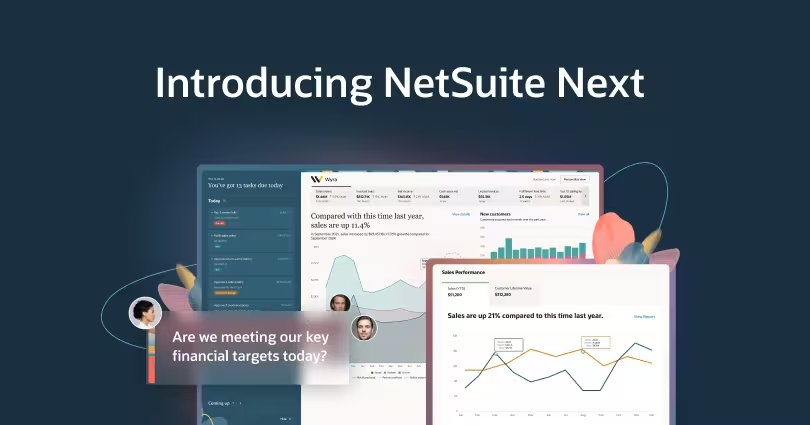
Image from NetSuite.com
Why Agentic AI Requires a Different Data Foundation
SuiteAgents are designed to reason about cause and effect. They need to understand not just that something changed, but why it changed, who was involved, and what action should follow.
If an agent only sees a daily sales journal or a batch inventory adjustment, it has no way to reason about underlying behavior. It cannot tell whether a specific SKU is underperforming because of pricing, promotion fatigue, poor placement, or a shift in customer mix. It cannot distinguish between a loyal customer reducing spend and a one-time buyer disappearing entirely.
Consider a realistic 2026 scenario. A high-value customer has not visited in three months. They walk into a store today. A NetSuite SuiteAgent could autonomously decide to trigger a targeted loyalty incentive at the point of sale, but only if it can see, in real time, that the customer has arrived, what they typically buy, and whether they are currently eligible. Without that live, customer-linked signal, the agent cannot act. The moment passes.
Agentic AI raises the cost of incomplete data. The more capable the AI becomes, the more damaging flattened data is.
Commerce AI Is Customer Intelligence
Commerce intelligence is not about totals. It is about customers.
NetSuite’s AI performs best when transactions are consistently linked to the NetSuite Customer Record and enriched with context captured at the moment of interaction. SKU-level sales, applied discounts, loyalty activity, returns, customer type, membership tier, region, and buying intent are not optional details. They are the raw material SuiteAgents need to reason accurately.
When transactions are not linked to customers inside NetSuite, AI can explain revenue movement but cannot understand behavior. It cannot separate loyalty from opportunism, identify emerging churn, or determine which customers are driving margin rather than volume.
Customer continuity is what turns data into intelligence.
Speed Is the Constraint in 2026
Granularity alone is not enough. Timing matters.
Batch syncing may still satisfy accounting requirements, but it undermines operational AI. In a world of hyper-local fulfillment, same-day availability, and real-time loyalty expectations, AI that operates on yesterday’s data is already late.
An inventory agent cannot prevent a stock-out if it only sees end-of-day totals. A customer agent cannot intervene if behavior is detected after the visit has ended. Agentic AI depends on real-time commerce signals.
From System of Record to System of Agency
This is the transformation NetSuite is driving.
In 2026, NetSuite is evolving from a system of record into a system of agency. With SuiteAgents, AI can autonomously suggest inventory transfers, prioritize operational exceptions, flag loyalty abuse, and guide decisions across commerce operations.
But an agent is only as effective as its visibility.
When NetSuite sees real-time, customer-linked commerce data, SuiteAgents gain the “eyes” they need to reason and act. When it does not, AI remains descriptive rather than operational.
Where Zoku Fits: Native to the Suite
Zoku was built to support this exact operating model.
Zoku’s data model is native to NetSuite, built on the NetSuite platform rather than integrated through external connectors. Commerce operations and the ERP reside on the same platform and share the same source of truth. There is no downstream syncing of summaries and no dependency on fragile API pipelines.
When a customer completes a transaction at a Zoku POS, the NetSuite Customer Record, transaction history, and inventory position are updated immediately. There is no delay and no data flattening.
Zoku is built on the NetSuite platform and operates with NetSuite as the single system of truth. While the Zoku Point Of Sale experience runs outside the NetSuite user interface for performance and usability reasons, all transactions, customer data, inventory movements, pricing rules, and AI-driven outcomes are governed by NetSuite. SuiteAgent signals, customer eligibility, pricing rules, inventory availability, and AI-driven priorities are surfaced directly to store personnel while decisions are being made.
The loop stays closed because the system is native, not bolted on.
The Takeaway
Agentic AI raises the bar for commerce architecture.
NetSuite’s SuiteAgents are designed to reason over real-time, customer-linked signals, not journal entries and batch files. Organizations that enable this data foundation will unlock far more value from NetSuite AI than those that continue to flatten reality before it reaches the platform.
Zoku exists to ensure NetSuite’s system of agency operates on what is happening now, not what happened yesterday. As AI moves from insight to action, that distinction becomes decisive.